Spiritual Information
Theory (SIT)
Theory (SIT)
A Short Introduction
by David Coppola
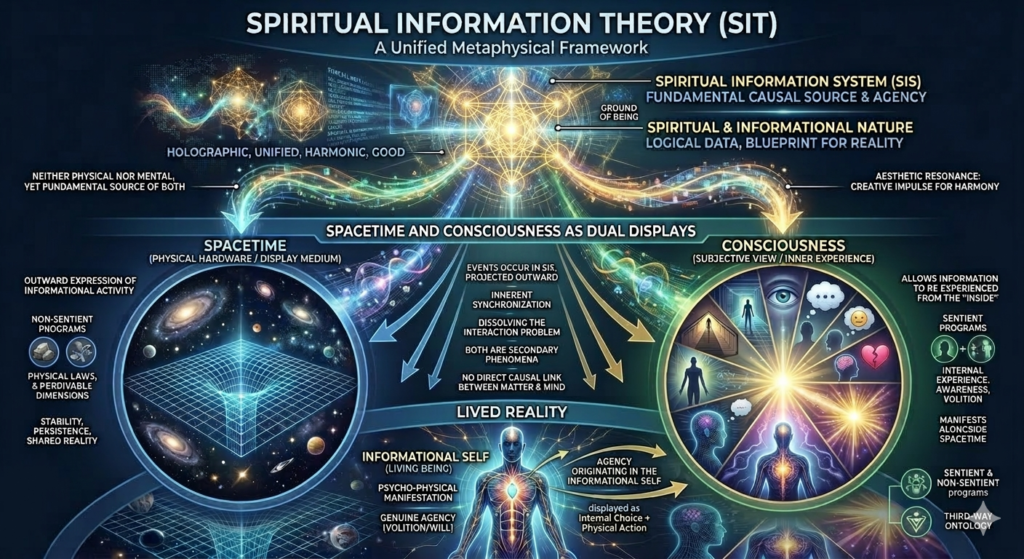
Spiritual Information Theory (SIT) is an unconventional yet innovative metaphysical framework proposing that the everyday universe which we perceive and inhabit is not a self-sufficient, self-sustaining world, but a derivative manifestation of a deeper, non-physical realm. Known in SIT as the Spiritual Information System, this underlying reality serves as the “ultimate reality” or “ground of being”—the cosmological source from which the observed universe originates. Unsatisfied with traditional metaphysical models such as materialism, idealism, and dualism, SIT thinks “outside the box” by asserting that neither spacetime nor consciousness constitutes the fundamental substance of reality; instead, both are secondary phenomena or “display mediums” that simultaneously emerge from this underlying reality. The Spiritual Information System itself is neither physical nor mental, yet it remains the fundamental source of both. While deeply mysterious, the Spiritual Information System has two distinguishable or “exoteric” properties: As the name implies, it is both spiritual as well as informational.
The spiritual nature of the Spiritual Information System is expressed in three main ways: Firstly, the Spiritual Information System constitutes a unified, holistic, and “holographic” system, where the Spiritual Information System and its internal parts form an indivisible whole, where every part is identical with the whole, and where the entire whole is present in every part. Secondly, the Spiritual Information System is fundamentally harmonic, where every action by a part affects the whole as well as every other part, and where every action by the whole reciprocally affects every part. Thirdly, the Spiritual Information System is fundamentally good, where the whole is inherently benevolent or “friendly” to itself and to each and every part, and where the whole “lovingly embraces” itself and each and every part at all times. As an informational entity, the Spiritual Information System possesses all of the “logical data” that forms the foundational structure of the phenomenal universe. This informational logic serves as the underlying formational blueprint for both physical reality and subjective experience.
One might view this convergence of spirituality and information through the lens of Aesthetic Resonance, where the Spiritual Information System does not process data out of mere necessity, but out of a desire for harmony. This creative impulse suggests that the “spiritual” is the reason why reality exists, while the “informational” provides the mechanics of how it is structured. Consequently, reality is an expression of internal benevolence manifested through the beauty of logical complexity.
An essential premise of Spiritual Information Theory is the assertion that both spacetime and consciousness are not only non-fundamental but non-causal mediums generated by the Spiritual Information System. In this model, neither the physical world nor the conscious mind possesses inherent agency or causative power. Instead, the Spiritual Information System serves as the primary source and location of all agency and causation. In other words, “everything that happens” occurs not in spacetime or consciousness, but more deeply within the Spiritual Information System itself. These causal events are thereafter projected outwardly through the “dual displays” of spacetime and consciousness to create the everyday experience of “lived reality.” By shifting the locus of action from the phenomenal world to the underlying source, SIT suggests that what we perceive as cause-and-effect in the perceived universe is merely the visible result of a deeper, non-physical informational process.
In Spiritual Information Theory, spacetime is framed as the structural manifestation or “physical hardware” of the Spiritual Information System. It represents the outward expression of informational activity in terms of dimensions, locality, and physical law. However, SIT emphasizes that this hardware is not the “floor” of existence. Rather, it is a high-level representation of an underlying non-spatial architecture. Just as a digital image is composed of underlying binary code that bears no physical resemblance to the picture on the screen, the world of spacetime with its four perceivable dimensions is a representational physical display of a deeper and complex informational architecture. Spacetime thus provides the stability and persistence required for a shared physical reality, acting as the stage for lived experience.
Consciousness, conversely, is the “subjective view” generated by the Spiritual Information System, allowing its information to be experienced from the “inside.” Rather than being “built” from matter, Spiritual Information Theory insists that subjective awareness is a primary output of the Spiritual Information System that manifests alongside and interfaces with the physical medium of spacetime. This approach bypasses the “Hard Problem of Consciousness” by treating subjectivity as a fundamental feature of the system’s output rather than a mysterious “ghost” that somehow evolves out of inert atoms.
Crucially, Spiritual Information Theory rejects the “materialist-idealist” binary that has dominated Western philosophical thought for centuries. Rather than treating spacetime as a self-existent container or consciousness as a mere byproduct of biology and evolution, SIT views both as “waves” atop a deeper, non-physical ocean. This underlying informational substrate provides the necessary data and logic for the universe to manifest its physical geometric properties while simultaneously providing the “subjective view” that allows for the emergence of consciousness. This ensures that reality is neither a cold, mechanical accident nor a solipsistic mental hallucination, but an inherently synchronized dual-aspect system.
Furthermore, Spiritual Information Theory maintains a strict boundary against traditional monism—the view that reality is “made of only one substance.” Rather than claiming that “all is matter” or “all is mind,” SIT functions as a “third-way ontology” by positing that both “matter” and “mind” are derivatives of a third, more fundamental reality. And unlike materialism or idealism, which seek to merge “matter” and “mind” into a single substance, SIT preserves their distinction as separate but synchronous manifestations, while rooted in a common informational architecture and governed by the same causal laws. By rooting both poles of existence in a single informational origin, SIT provides a fertile, unified ground where the laws of physics and the facts of experience can coexist without one needing to be “reduced” to the other.
One of the hallmarks of Spiritual Information Theory is its rigorous resolution to the “interaction problem” found in Cartesian dualism, which posits the existence of “matter” and “mind” as two independent and incompatible substances, and yet deeply struggles to explain how they interact with one another. SIT doesn’t just solve this problem but dissolves it entirely by revealing that spacetime and consciousness do not need to causally interact with each other at all, because neither one is the place where agency or causation happens. This way, the apparent coordination or “synchronization” between the physical and mental mediums is not coincidental but inherent, as both are generated by the same underlying source. Because the physical and the mental are “dual displays” of the same informational activity, their synchronization is a logical necessity of their shared origin. Thus SIT allows for a coherent universe without the mysterious causal leaps required by traditional dualistic models.
In Spiritual Information Theory, all entities within the phenomenal world are viewed as manifestations of either “sentient programs” or “non-sentient programs” within the Spiritual Information System, much like “subprograms” within an overarching software architecture. Conscious beings represent sentient programs, while inert objects and non-conscious phenomena such as physical laws are manifestations of non-sentient programs, governed by the same underlying computational logic. This categorization provides a coherent framework for understanding the difference between living organisms and inanimate matter while maintaining a unified origin. All of the logic and data accounting for everything in the phenomenal world is contained and processed within the Spiritual Information System. Whether an entity is a conscious observer or a physical object, it remains an expression of the same foundational informational “script.”
One of the most significant implications of Spiritual Information Theory is the framing of “living beings” as manifestations of the Informational Self. In this framework, a biological organism, with a physical body and an internal subjective state, is itself a type of “display”—an outward psycho-physical manifestation of a deeper spiritual and informational identity which “lives and breathes” within the vital environment of the Spiritual Information System. This Informational Self is not separate from the Spiritual Information System but is an integral part and holographic reflection of it, mirroring both its spiritual as well as its informational nature. Crucially according to SIT, the felt sense of agency (aka “volition” or “will”) experienced by conscious beings is not an illusion in any sense, but is real genuine agency originating in the Informational Self. This agency is displayed outwardly as the internal experience of choice combined with the physical fact of action. In SIT, agency is an intrinsic feature of the Informational Self, making it a genuine participant in the Spiritual Information System’s causal activity.
Spiritual Information Theory (SIT) presents an unconventional but innovative model of a universe that is mysterious yet intelligible, where the “outer” world of extension and the “inner” world of thought are distinct but harmonious expressions of a singular underlying truth. Identifying the Spiritual Information System as the cosmological source of both spacetime and consciousness, SIT competently bridges the philosophical gap between the mathematical patterns of physics and the qualitative depths of the mind. By framing the Spiritual Information System as not only informational, but fundamentally good as well as internally harmonic and holographic, SIT provides not only a metaphysical model but a deep spiritual framework. And with its innovative and evocative concepts of the Informational Self and of sentient and non-sentient programs, SIT provides a profound and satisfying perspective for understanding life, consciousness, and physical reality. Ideally, SIT will inspire innovative thinking and constructive conversation not only from physicists, philosophers, spiritualists, and information theorists, but from everyone who contemplates and understands it deeply.